
Introduction
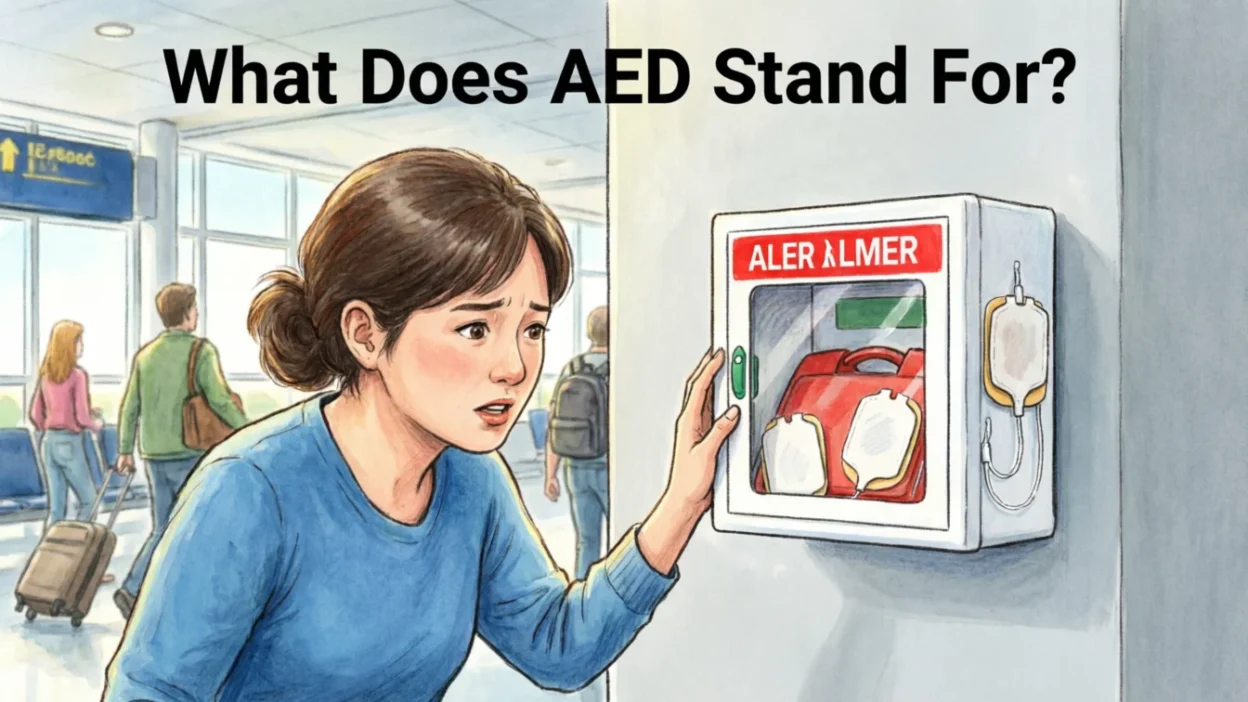
Imagine you’re at a gym, airport, or school when suddenly someone collapses. People rush over to help, and someone quickly grabs a small box from the wall labeled AED.
You may have seen these devices before but wondered what the letters actually mean. Many people ask the same question online: what does AED stand for?
Understanding this simple abbreviation is important because AEDs play a huge role in saving lives during emergencies.
In this guide, we’ll explain what AED means, how it’s used, and why it’s such an important device in public places today.
Quick Answer:
AED stands for Automated External Defibrillator, a portable medical device used to help restart a person’s heart during sudden cardiac arrest.
What Does AED Stand For?
When people ask “what does AED stand for?”, they are referring to a medical device used in emergency situations.
AED = Automated External Defibrillator
Let’s break down the words to understand the meaning.
- Automated – The device can automatically analyze the heart’s rhythm.
- External – It works from outside the body using pads placed on the chest.
- Defibrillator – A device that sends an electric shock to restore a normal heartbeat.
Plain-English Explanation
An AED is a portable machine that checks a person’s heartbeat and delivers an electric shock if needed to help restart the heart.
It is designed to be used by ordinary people, not just doctors, during emergencies before professional medical help arrives.
Why People Use the Term AED
The abbreviation AED is commonly used because the full name—Automated External Defibrillator—is long. In emergencies, shorter terms help people communicate quickly.
Simple Example
Example sentence:
“someone quickly brought the aed from the hallway to help the person who collapsed.”
Bold Summary:
AED stands for Automated External Defibrillator, a device that can help restart a person’s heart during sudden cardiac arrest.
Where the Term AED Is Commonly Used
The abbreviation AED is widely used in healthcare, emergency response, and public safety.
1. Public Places
AED devices are often installed in places where many people gather, such as:
- airports
- shopping malls
- schools
- gyms
- stadiums
They are usually mounted on walls inside clearly marked emergency boxes.
2. Emergency Medical Training
People learning CPR or first aid are taught how to use an AED during cardiac emergencies.
3. Workplaces
Many companies install AEDs in offices to improve workplace safety.
4. Schools and Universities
Schools often keep AED devices in hallways, sports areas, or nurse’s offices.
5. Online Health and Safety Discussions
The term also appears in articles, safety training guides, and social media posts related to emergency response.
Tone and Context
- serious and medical
- used in both formal and practical situations
- commonly associated with life-saving emergencies
Real-Life Conversation Examples
Here are realistic examples of how people might mention AED in everyday conversation.
- “does anyone know where the aed is in this building?”
- “the gym installed a new aed near the entrance.”
- “the instructor showed us how to use an aed during cpr training.”
- “someone grabbed the aed when the man collapsed.”
- “schools keep an aed in case of emergencies.”
- “the device tells you exactly how to use the aed.”
- “they saved his life using an aed before the ambulance arrived.”
- “every office should have an aed for safety.”
These examples show how the abbreviation appears in real-life discussions.
When to Use and When Not to Use the Term AED
Understanding the correct context helps people use the term AED properly.
Do Use AED When
- talking about emergency medical devices
- discussing CPR or first aid training
- referring to public safety equipment
Don’t Use AED When
- discussing regular medical equipment unrelated to heart emergencies
- talking about non-medical technology
- using it as slang or casual language
Quick Comparison Table
| Context | Example Phrase | Why It Works / Doesn’t Work |
|---|---|---|
| emergency situation | “bring the aed quickly!” | correct emergency usage |
| training class | “we learned how to use an aed.” | accurate context |
| office safety | “our building installed an aed.” | appropriate use |
| casual tech discussion | “my phone works like an aed.” | incorrect comparison |
Related Medical Terms
Several medical terms are closely related to AED and emergency heart care.
| Term | Meaning | When It’s Used |
|---|---|---|
| CPR | cardiopulmonary resuscitation | manual chest compressions to help circulation |
| defibrillator | device that restores heart rhythm | general medical term |
| cardiac arrest | when the heart suddenly stops beating | emergency condition |
| first aid | immediate medical assistance | early emergency response |
| emergency response | quick action during a crisis | safety and rescue situations |
These terms often appear together in discussions about emergency medical care.
FAQ: What Does AED Stand For?
1. What does AED stand for?
AED stands for Automated External Defibrillator, a portable device used to help restart the heart during sudden cardiac arrest.
2. What does an AED actually do?
An AED analyzes the heart’s rhythm and delivers an electric shock if needed to restore a normal heartbeat.
3. Can anyone use an AED?
Yes. AEDs are designed so ordinary people can use them during emergencies, even without medical training.
4. Where are AED devices usually located?
They are commonly found in airports, schools, gyms, malls, offices, and stadiums.
5. Does an AED replace CPR?
No. CPR and AEDs are often used together to increase the chance of survival.
6. Is using an AED dangerous?
When used correctly, AEDs are safe and designed to guide the user with voice instructions.
7. Why are AEDs important?
They can greatly increase survival chances when used quickly during sudden cardiac arrest.
Final Thought
So, what does AED stand for? It stands for Automated External Defibrillator, a life-saving device designed to help restore a normal heartbeat during sudden cardiac arrest.
You may see AED devices in public places like airports, gyms, schools, and offices. These machines are simple to use and provide step-by-step instructions during emergencies.
Understanding what an AED is and how it works can make a huge difference. In critical situations, quick action with an AED can help save a life before medical professionals arrive.


