Introduction
You’re in a business meeting or watching a tech video, and someone suddenly says, “We need a better ERP system.” Everyone nods like it’s obvious. Meanwhile, you’re sitting there wondering, what does ERP stand for?
It sounds technical and important — and it is. ERP is a common term in the business and software world, especially when companies talk about managing money, employees, or inventory.
If you’ve seen this abbreviation in job descriptions, company websites, or tech discussions, you’re not alone. In this guide, we’ll break down what ERP means in simple language and explain why it matters.
Quick Answer:
ERP stands for Enterprise Resource Planning, which is software that helps businesses manage their daily operations in one system.
What Does ERP Stand For?
When people ask “what does ERP stand for?”, they are usually talking about business software.
ERP = Enterprise Resource Planning
Let’s break that down.
- Enterprise – a business or organization
- Resource – things a company uses, like money, employees, and products
- Planning – organizing and managing those resources
Plain-English Explanation
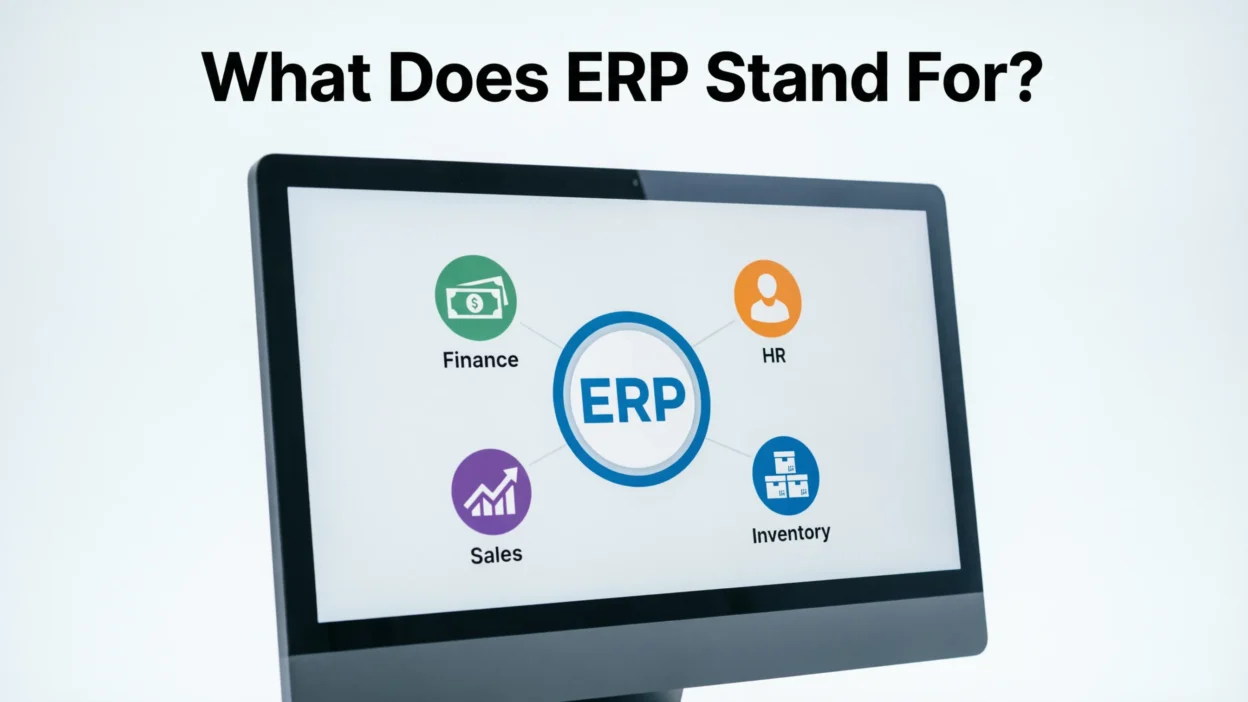
ERP is a type of software that helps companies manage important tasks in one central system.
Instead of using separate programs for accounting, payroll, inventory, and sales, an ERP system connects everything together.
Why Companies Use ERP
Businesses use ERP systems to:
- track money and accounting
- manage inventory and products
- handle employee payroll
- monitor sales and orders
- improve efficiency
It helps companies stay organized and reduce errors.
Simple Example
Example sentence:
“our company uses an erp system to manage inventory and payroll.”
Bold Summary:
ERP stands for Enterprise Resource Planning, a system that helps businesses manage finances, employees, and operations in one place.
Where the Term ERP Is Commonly Used
The abbreviation ERP appears in many business and technology conversations.
1. Business Meetings
Managers often discuss ERP when planning company systems or improving efficiency.
2. Job Descriptions
Many job listings mention experience with ERP systems, especially in:
- accounting
- supply chain
- finance
- operations
3. Technology and Software Discussions
IT professionals talk about ERP when installing, upgrading, or managing business software.
4. Manufacturing and Retail
ERP is especially common in industries that manage:
- large inventories
- warehouses
- product distribution
Tone and Context
ERP is usually:
- formal and professional
- used in business and corporate settings
- technical but widely recognized in the workplace
Realistic Conversation Examples
Here are natural examples of how ERP is used in everyday professional conversations.
- “we’re upgrading our erp system next year.”
- “does the erp track inventory automatically?”
- “i have experience working with erp software.”
- “the erp helps us manage payroll and accounting.”
- “our old erp system was too slow.”
- “the company invested in a new erp solution.”
- “we integrated the erp with our sales platform.”
- “the erp generates monthly financial reports.”
These examples show how common the term is in business communication.
When to Use and When Not to Use ERP
Understanding the right context helps avoid confusion.
Do Use ERP When
- talking about business management software
- discussing company operations
- referring to enterprise systems
Don’t Use ERP When
- discussing personal budgeting apps
- talking about small everyday tools
- using slang in casual chats
Quick Comparison Table
| Context | Example Phrase | Why It Works / Doesn’t Work |
|---|---|---|
| corporate setting | “we implemented a new erp.” | correct professional use |
| job interview | “i have erp experience.” | relevant skill |
| personal app | “my grocery app is an erp.” | not accurate |
| casual texting | “lol erp is fun.” | doesn’t fit context |
Similar Business and Software Terms
Here are related terms often mentioned with ERP.
| Term | Meaning | When It’s Used |
|---|---|---|
| CRM | Customer Relationship Management | managing customer data |
| HR software | Human Resources systems | managing employees |
| accounting software | financial management tools | tracking money |
| supply chain management (SCM) | managing product flow | logistics and distribution |
| business management system | general operations software | broad business use |
ERP is different because it combines multiple systems into one platform.
FAQ: What Does ERP Stand For?
1. What does ERP stand for?
ERP stands for Enterprise Resource Planning, a type of business management software.
2. What does an ERP system do?
An ERP system helps companies manage accounting, inventory, payroll, sales, and operations in one place.
3. Who uses ERP software?
ERP software is used by:
- large companies
- manufacturers
- retailers
- corporate offices
4. Is ERP only for big companies?
While ERP is common in large businesses, smaller companies can also use simplified ERP systems.
5. Is ERP technical?
Yes, it involves software systems, but many employees use it daily without needing advanced technical knowledge.
6. What’s the difference between ERP and CRM?
ERP manages overall business operations, while CRM focuses on managing customer relationships.
7. Why is ERP important?
ERP helps improve organization, efficiency, and accuracy in business processes.
Final Thought
So, what does ERP stand for? It stands for Enterprise Resource Planning, a powerful software system that helps businesses manage their resources, finances, and operations in one connected platform.
From tracking inventory to handling payroll, ERP systems play a major role in modern companies. While the term may sound technical at first, its purpose is simple: to help businesses run smoothly and stay organized.
Understanding ERP can also be helpful if you work in business, finance, IT, or management.