The first time many people hear martial law, it’s not in a textbook—it’s in a late-night tweet, a breaking-news alert, or a tense group chat message like, “wait… is martial law happening?”
That moment can feel confusing and a little scary. The term sounds intense, and online conversations often make it feel even bigger than it is.
If you’ve ever paused mid-scroll and wondered what does martial law mean, you’re not alone. Let’s break it down in plain language, without the drama, so you can understand what people really mean when they use it in texts, comments, and online chats.
Quick Answer
Martial law means the military temporarily takes control of law enforcement when normal civilian government cannot function.
What Does Martial Law Mean in Plain English?
Martial law is not a slang term and has no full form or texting abbreviation. It’s a legal and political term.
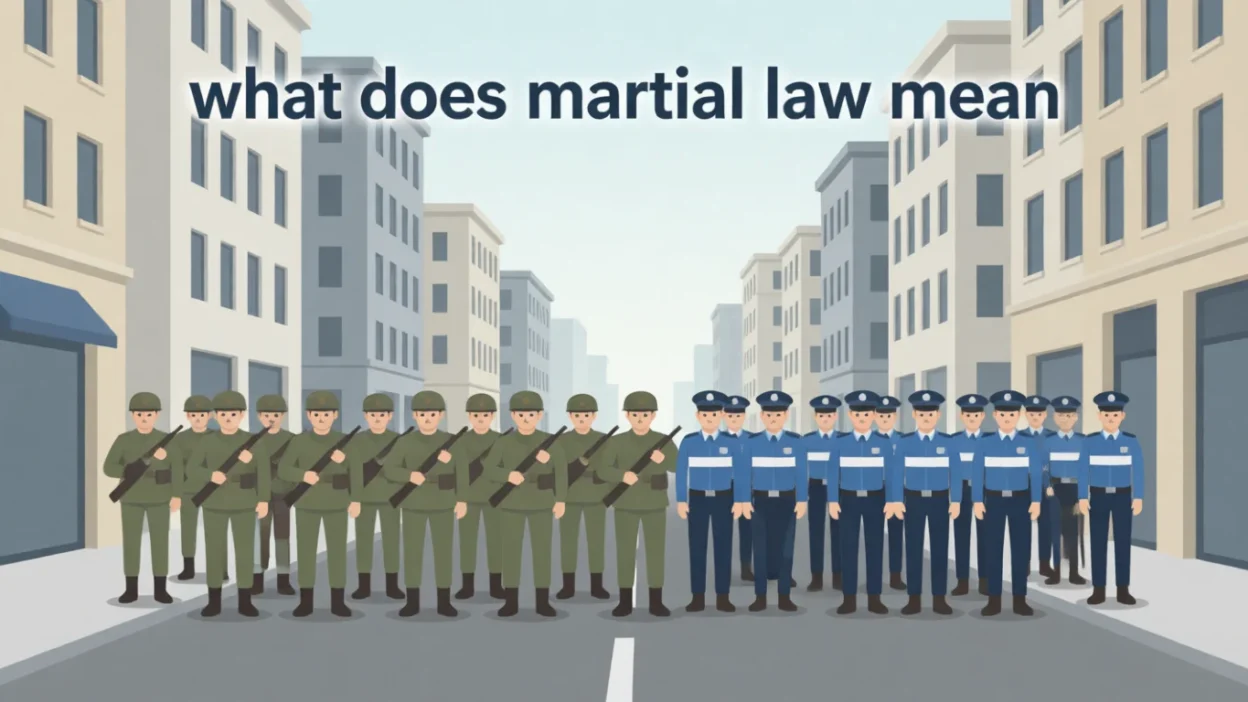
In simple words, martial law happens when the military steps in to keep order because the regular government, police, or courts can’t handle a serious situation.
This usually happens during:
- extreme emergencies
- wars or invasions
- large-scale unrest
- natural disasters
Under martial law, some normal laws may be limited, and the military may enforce rules instead of civilian authorities.
Why People Use the Term
People use “martial law” to describe moments when:
- things feel out of control
- governments use emergency powers
- soldiers appear on streets
- strict rules are enforced quickly
It’s often used in online discussions to express concern, fear, or urgency.
Simple Example Sentence
Bold summary: martial law means the military temporarily runs things during a major emergency.
Where Is Martial Law Commonly Mentioned Online?
Even though martial law is a serious term, it shows up often in digital spaces.
Common Places You’ll See It
- news headlines shared on social media
- twitter (x) and facebook comments
- whatsapp and telegram group chats
- reddit threads and political forums
- gaming chats during joking exaggerations
- youtube comment sections
Tone and Usage
- tone: formal to neutral
- context: serious, informational, sometimes exaggerated
- not slang, but sometimes used casually or dramatically
In texting culture, people may use it loosely—even when the situation doesn’t actually meet the real definition.
Realistic Conversation Examples (Texting Style)
Here’s how “martial law” shows up in real online chats. All lowercase, just like everyday texting.
- “people are saying martial law might be declared”
- “nah this isn’t martial law, just stricter rules”
- “seeing soldiers outside doesn’t always mean martial law”
- “twitter is panicking about martial law again”
- “martial law trends every time there’s a crisis”
- “that lockdown felt like martial law tbh”
- “if courts stop working, that’s closer to martial law”
- “don’t spread rumors about martial law without facts”
These examples show how the term is used seriously, casually, and sometimes incorrectly.
When to Use and When Not to Use Martial Law
Because it’s a strong term, knowing when to use it matters.
✅ When to Use It
- when discussing real legal or political events
- when referencing official announcements
- in news-related or educational conversations
- when explaining emergency government powers
❌ When Not to Use It
- as a joke about minor rules
- to exaggerate normal restrictions
- in casual memes without context
- to spread fear or rumors
Quick Comparison Table
| Context | Example Phrase | Why It Works / Doesn’t |
|---|---|---|
| news discussion | “martial law was officially declared” | works—accurate context |
| history lesson | “martial law limited civilian control” | works—educational |
| casual rant | “school rules feel like martial law” | doesn’t work—exaggerated |
| meme joke | “martial law because wifi is down” | doesn’t work—misleading |
Similar Terms and Alternatives You Might See
People often confuse martial law with other emergency-related terms. Here’s how they differ.
| Term | Meaning | When to Use |
|---|---|---|
| state of emergency | government gets extra powers | common alternative |
| curfew | restricted movement at night | limited control |
| military control | army involved in governance | informal description |
| lockdown | movement restrictions | public health or safety |
| emergency powers | temporary authority expansion | legal discussions |
In informal chat or social media slang, people often say “lockdown” or “emergency rule” instead of martial law, even when it’s not technically correct.
FAQ: Common Questions About Martial Law
1. What does martial law mean in simple terms?
It means the military temporarily controls law enforcement during a major emergency.
2. Is martial law a slang term?
No. It’s a formal legal and political term.
3. Does martial law mean all rights are gone?
Not always. Some rights may be limited, but it depends on the situation and country.
4. Can martial law be used casually in texting?
People do use it casually, but it’s often inaccurate or exaggerated.
5. Is martial law common today?
No. It’s rare and usually temporary.
6. Why does martial law trend on social media?
Because it sounds serious and spreads fast during crises or rumors.
7. Is martial law the same as a lockdown?
No. A lockdown restricts movement; martial law changes who enforces the law.
Why Martial Law Comes Up So Often Online
In today’s digital world, news spreads instantly. Any sign of:
- soldiers on streets
- strict rules
- emergency announcements
can cause people to jump to conclusions. Social media slang and informal chat often blur the line between real martial law and normal emergency measures.
That’s why understanding what does martial law mean helps you:
- avoid misinformation
- stay calm during news cycles
- explain facts clearly in online conversations
Knowledge cuts through panic.
Final Thought
So, what does martial law mean?
It means the military temporarily steps in to control law and order when civilian systems fail.
While the term is formal, it shows up often in texting culture, social media, and online chats—sometimes correctly, sometimes not. Knowing the real meaning helps you separate facts from fear and use the term responsibly in modern digital communication.